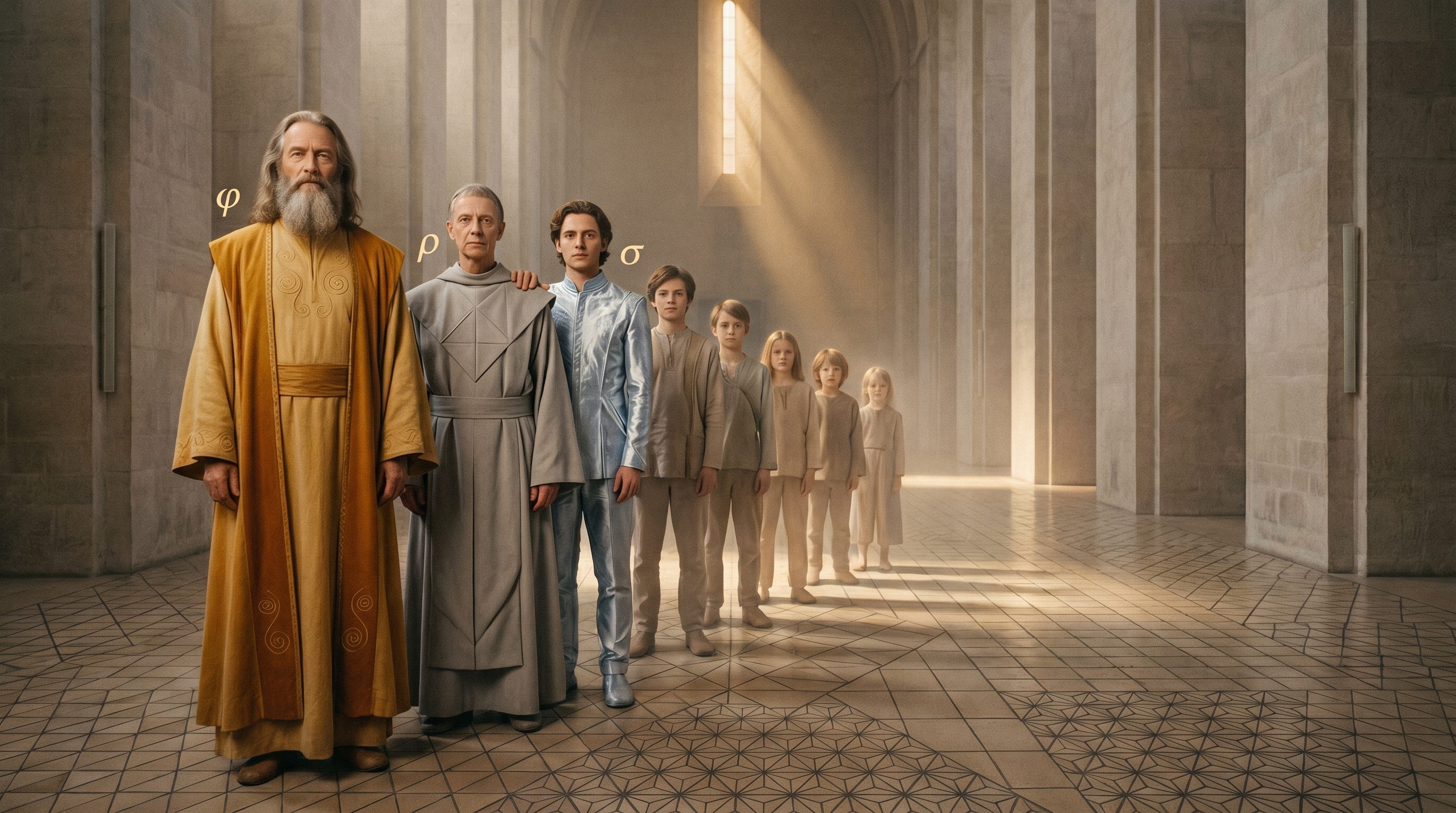
The golden ratio is one of the oldest constants in mathematics.
φ ≈ 1.618 — the unique positive root of x² = x + 1. It appears in Fibonacci spirals, pentagon geometry, and the proportions that Renaissance artists called divine. It is the organizing constant of two-dimensional simplicial geometry.
Fewer people know its three-dimensional successor.
The Plastic Constant
ρ ≈ 1.325 — the unique positive root of x³ = x + 1. Where φ governs flat geometry, ρ governs three-dimensional simplicial structures. It generates the Padovan sequence (1, 1, 1, 2, 2, 3, 4, 5, 7, 9, 12...) the same way φ generates the Fibonacci numbers. The ratio of consecutive Padovan terms converges to ρ.
ρ has been studied since the 1920s, but it found its most remarkable application in the hands of someone who was not a mathematician.
The Monk Who Built with ρ
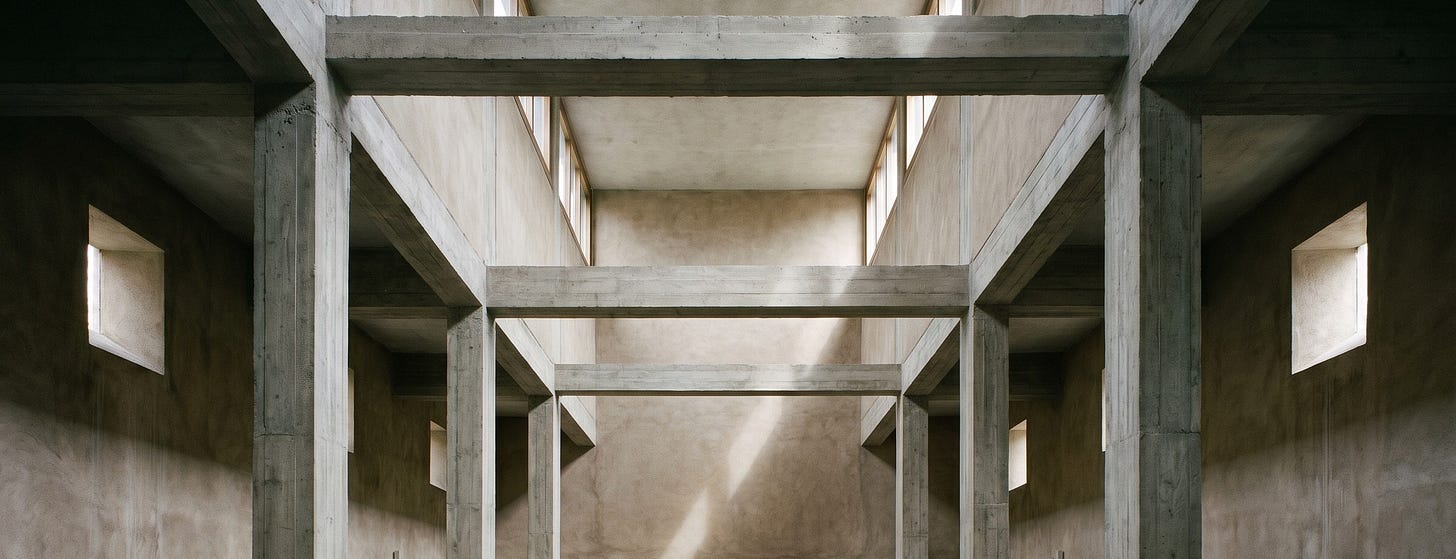
In the 1960s, a Dutch Benedictine monk named Dom Hans van der Laan made a discovery that connected number theory to architecture.
Van der Laan showed that a three-dimensional box with side ratios {1, ρ, ρ²} can be recursively cut along its longest side, and the resulting pieces reproduce the original family of proportions. Not approximately. Exactly. The system closes at exactly 10 proportional types. Cut any of the 10, and you get only shapes you have already seen.
ρ is the unique positive real number that makes this work in three dimensions. Van der Laan used this property to design monastery churches of extraordinary spatial harmony — proportions that are balanced precisely because they are not obvious. He called it an architecture of silence.
Whether this construction extends beyond three dimensions remained an open question for sixty years.

Dom Hans van der Laan (1904–1991) was a Dutch Benedictine monk and architect. He was a leading figure in the Bossche School. His architectural theories about the plastic number and the spatial proportions of buildings based on the human scale were applied in the design of the St. Benedictusberg Abbey in Vaals.
The Family
The answer required stepping back and seeing the larger pattern.
The equations x² = x + 1 and x³ = x + 1 look unrelated when you encounter them separately — one tied to spirals and pentagons, the other to Padovan numbers and monastery churches. But they share the same structure: raise x to a power, and ask when the result equals x + 1. The only difference is the exponent.
This is not a coincidence. They are the first two members of an infinite polynomial family: x^d = x + 1, one equation for every integer d ≥ 2. And each equation has exactly one positive real root — a single number that satisfies it. Not two roots, not a range. One.
Why exactly one? Because the left side, x^d, grows faster and faster as x increases, while the right side, x + 1, grows at a fixed rate. They start equal at some point and never meet again. That crossing point is the constant for dimension d.
Each of these constants organizes the geometry of its dimension in the same way. In two dimensions, φ governs the proportions of triangles and pentagons — the simplest flat shapes. In three dimensions, ρ governs tetrahedra and the spatial proportions Van der Laan used for his churches. In four dimensions, σ governs pentatopes — the four-dimensional analog of the tetrahedron. The pattern continues: each constant captures the natural proportions of the simplest shape in its dimension.
Here are the first ten:
| d | Equation | Constant | Name |
|---|---|---|---|
| 2 | x² = x + 1 | φ ≈ 1.61803 | Golden Ratio |
| 3 | x³ = x + 1 | ρ ≈ 1.32472 | Plastic Constant |
| 4 | x⁴ = x + 1 | σ ≈ 1.22074 | Sigma Constant |
| 5 | x⁵ = x + 1 | ≈ 1.16730 | (unnamed) |
| 6 | x⁶ = x + 1 | ≈ 1.13472 | (unnamed) |
| 7 | x⁷ = x + 1 | ≈ 1.11278 | (unnamed) |
| 8 | x⁸ = x + 1 | ≈ 1.09698 | (unnamed) |
| 9 | x⁹ = x + 1 | ≈ 1.08507 | (unnamed) |
| 10 | x¹⁰ = x + 1 | ≈ 1.07577 | (unnamed) |
| ∞ | — | → 1.00000 | Isotropic limit |
One polynomial family. One constant per dimension. The first three have established names. The rest — every constant from d = 5 onward — remain unnamed in the literature.
And they all converge to 1.
The Descent Toward One
When we first computed this table — ten dimensions, ten constants, all marching toward 1 — the pattern was clear but the meaning was not. A hierarchy of numbers approaching the identity could be trivial. It could be an artifact of the polynomial family. It took longer than it should have to see what the convergence was actually saying.
It is saying something about geometry.
In two dimensions, there are preferred directions. A triangle has distinct edges and vertices. The golden ratio captures this anisotropy — the geometric fact that some directions matter more than others.
In three dimensions, the anisotropy softens. A tetrahedron has more faces, more symmetry axes. The plastic constant is smaller than φ because 3D space is less directional than 2D.
In four dimensions, the anisotropy softens further still. A pentatope has more faces and more symmetry axes than a tetrahedron, just as a tetrahedron has more than a triangle. The sigma constant is smaller than ρ because 4D space is less directional than 3D.
In infinite dimensions, every direction is equally important. No preferred axis. No special face. The organizing constant is 1 — the identity. It tells you nothing special, because there is nothing special to tell.
The sequence φ → ρ → σ → ... → 1 is a hierarchy of diminishing geometric information. Each constant captures the anisotropy of its dimension. As dimension grows, anisotropy vanishes, and the constant converges to the number that carries no information at all.
Isotropy is the destiny of infinite dimensions.
Three Independent Confirmations
Beyond the convergence pattern itself, three independent lines of evidence support the family.
Each constant has its own number sequence. The golden ratio is the growth rate of the Fibonacci sequence — each term is the sum of the two before it. The plastic constant is the growth rate of the Padovan sequence — each term is the sum of the two three apart. In general, the constant of dimension d governs a sequence where each term reaches further back into its own history. The Fibonacci sequence reaches back 2 steps. The Padovan reaches back 3. The σ-sequence reaches back 4.
Each constant emerges from its lattice. When you simulate how energy spreads on a lattice — a regular geometric grid in d dimensions — the rate at which energy decays from one lattice point to the next is not a free parameter you choose. The lattice chooses it for you. For the triangular lattice (d=2), the natural decay rate is 1/φ. For the tetrahedral lattice (d=3), it is 1/ρ. For the four-dimensional simplicial lattice (d=4), it is 1/σ.
σ has a closed arithmetic. Because σ⁴ = σ + 1, every power of σ can be reduced to a combination of just four building blocks — {1, σ, σ², σ³}:
σ⁵ = σ² + σ
σ⁶ = σ³ + σ²
σ⁷ = σ³ + σ + 1
σ⁸ = σ² + 2σ + 1
No power of σ — not σ¹⁰⁰, not σ¹⁰⁰⁰ — ever requires a fifth building block. The arithmetic is permanently closed. Four basis elements for a four-dimensional constant.
The Monk's Question, Answered
Which brings us back to Van der Laan.
If the golden ratio closes a self-similar subdivision at 3 types in two dimensions, and the plastic constant closes at 10 types in three dimensions — does σ close the system in four?
It does. The σ-hyperbox {1, σ, σ², σ³} self-similarly subdivides into a closed family of exactly 35 unique proportional types. Cut the longest side of any shape in the family, and the two resulting pieces are always members of the same family. No exceptions. The algebra σ⁴ = σ + 1 guarantees exact volume conservation at every cut.
We proved this by exhaustive breadth-first enumeration. The system closed at 35. We ran it again. 35. Then we ran it in five dimensions. 126 types. Six dimensions. 462 types. And the numbers looked familiar.
| Dimension | Constant | Box Types | Formula | Verified |
|---|---|---|---|---|
| 2 | φ (Golden Ratio) | 3 | C(3,1) = 3 | ✓ |
| 3 | ρ (Plastic Constant) | 10 | C(5,2) = 10 | ✓ |
| 4 | σ (Sigma Constant) | 35 | C(7,3) = 35 | ✓ |
| 5 | σ₅ | 126 | C(9,4) = 126 | ✓ |
| 6 | σ₆ | 462 | C(11,5) = 462 | ✓ |
3, 10, 35, 126, 462. The formula wrote itself:
Van der Laan's 10 types in three dimensions — the proportions that gave his monastery churches their spatial harmony — are C(5,2). The 35 types in four dimensions are C(7,3). The pattern was there the whole time, waiting in the combinatorics for someone to run the construction past d = 3.
Putting It Together
Edition 1 introduced σ as a single number — the golden ratio's four-dimensional analog.
The picture is now considerably larger. Three independent lines of evidence — spectral validation across three lattice dimensions, algebraic verification of the sparse recurrence family, and Van der Laan self-similar subdivision extended to four dimensions and beyond — all point to the same structure.
The polynomial family x^d = x + 1 generates a sequence of geometry-native organizing constants for the A_d root lattice family. Each constant governs the natural timescale of diffusion on its lattice. Each generates a closed algebraic structure. Each admits self-similar geometric subdivision into a finite, predictable family of types.
The first two constants — φ and ρ — have established names and decades of literature. We named the third one σ in our first paper. The constants for d ≥ 5 remain unnamed and, as far as we can determine, unstudied in this context.
What Comes Next
Edition 1 introduced the constants. Here in Edition 2, we proved they solve a sixty-year-old counting problem — the number of compositions of $n$ avoiding a consecutive pattern is governed by the positive root of $x^d = x + 1$.
But these constants do more than count. In Edition 3, we show that the same algebraic identity produces a universal growth partition law: in every dimension, the boundary and interior propagation fractions sum exactly to one. We call it the Semantic Octave.
Casey Lee Race, Founder King, Calera Computing, Inc.
📄 Paper (B02): "The x^d = x + 1 Hierarchy: Cross-Dimensional Spectral Validation on A_d Root Lattices" 🔗 DOI: 10.5281/zenodo.20692936 💻 Verification Scripts: github.com/Calera-Computing-Inc/cross-dimensional-hierarchy-verification
📄 Paper (B01): "The σ-Constant: A Universal Algebraic Invariant for Energy Propagation in d-Dimensional Simplicial Lattices" 🔗 DOI: 10.5281/zenodo.20350425 💻 Verification Scripts: github.com/Calera-Computing-Inc/sigma-constant-verification