A Penrose tiling looks like an accident of art. It is not. It arises through a precise cut-and-project construction from a periodic object in four dimensions — and for more than a hundred years, periodic crystallography held that its visible symmetry could not exist.
In 1982, Dan Shechtman saw something impossible.
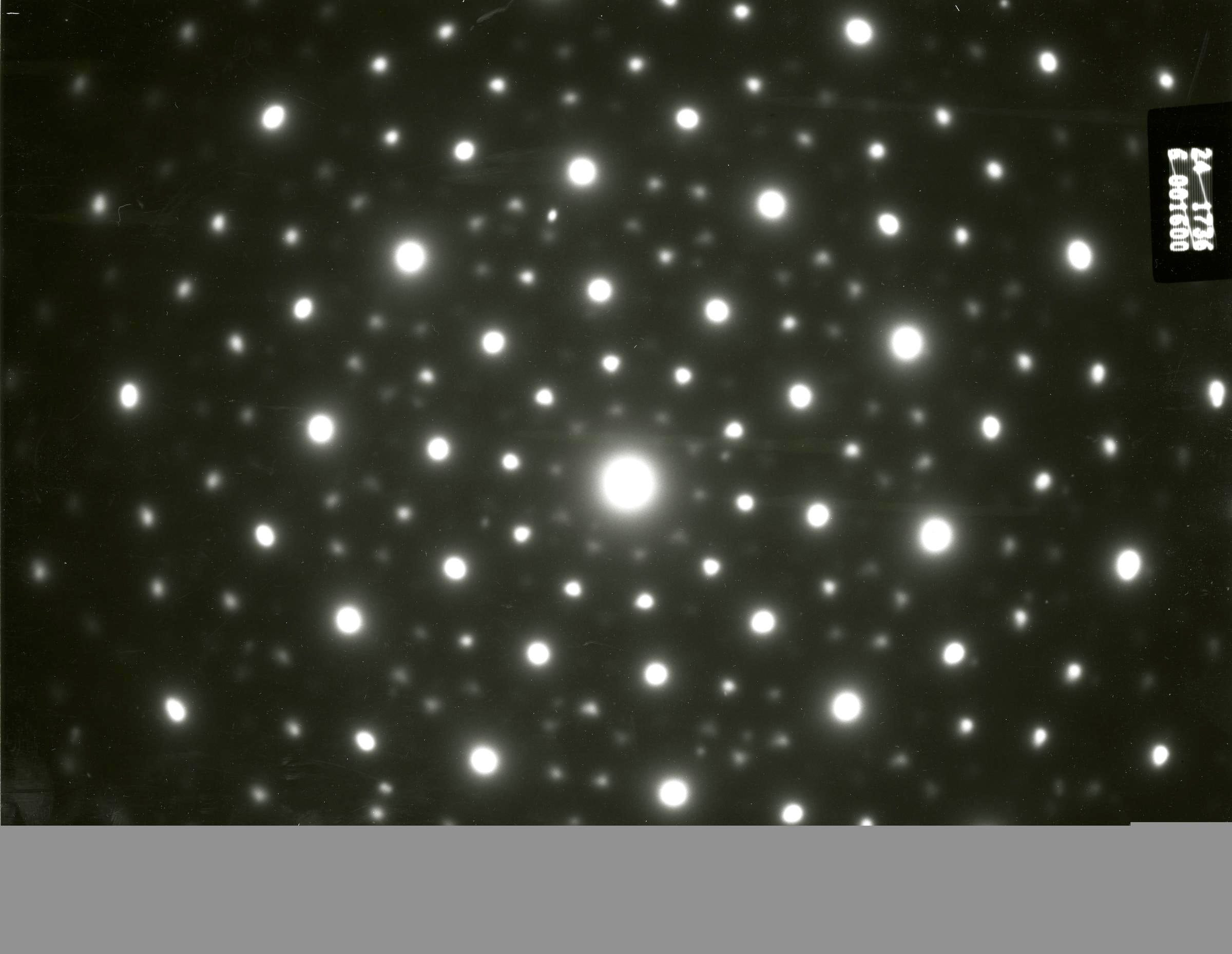
He was studying a rapidly cooled aluminum-manganese alloy at the National Bureau of Standards. The electron diffraction pattern on his screen showed ten-fold rotational symmetry — ten bright spots arranged in a perfect decagonal ring. Sharp. Clean. Unmistakable.
And forbidden by the rules then used for periodic crystals.
For more than 150 years, crystallography had rested on a theorem: periodic crystals can have only 2, 3, 4, or 6-fold rotational symmetry. First proved by Johann Hessel in 1830 and independently rediscovered by Axel Gadolin in 1867, the crystallographic restriction theorem held that five-fold and ten-fold symmetry are incompatible with a repeating unit cell. It was a central constraint of classical crystallography.
Shechtman's diffraction pattern had ten-fold symmetry. The material was ordered — the sharp peaks showed long-range structure — but it did not repeat. It was an aperiodic crystal: a category the field would soon have to recognize explicitly.
He told his colleagues. They did not believe him. Linus Pauling — two-time Nobel laureate — said publicly:
"There is no such thing as quasicrystals, only quasi-scientists."
— Linus Pauling, two-time Nobel laureate, to Dan Shechtman
Shechtman spent the next decade defending his data. In 1992, the International Union of Crystallography changed the definition of "crystal" to accommodate his discovery. In 2011, he won the Nobel Prize in Chemistry.
The mathematical models developed for this class of quasicrystal prominently feature the golden ratio.
The Golden Ratio in Matter
Quasicrystals are materials whose atoms are arranged in ordered patterns that never repeat. They have sharp diffraction peaks — the signature of long-range order — but no translational symmetry. They tile space the way Penrose tiles cover a floor: filling every gap, leaving no voids, yet never settling into a periodic rhythm.
In the canonical Penrose and icosahedral models, the golden ratio is structurally central.
In ideal Fibonacci, Penrose, and Ammann–Kramer models, length scales, reciprocal-space peak families, and inflation structure are related by powers of φ. Particular atomic-layer ratios depend on the material and the direction chosen; φ is a feature of these models, not a universal ratio for every quasicrystal measurement.
This is the same φ from Edition 1 — the unique positive root of x² = x + 1, approximately 1.618.
In Edition 1, we showed that φ is the positive root of the two-dimensional member of the hierarchy. In Penrose tilings and the standard mathematical models of five-fold quasicrystalline order, the same number appears for an independent geometric reason: pentagonal symmetry and its cut-and-project construction.
Penrose, Before Shechtman
Roger Penrose discovered the mathematical prototype in 1974, eight years before Shechtman's experiment.
Penrose showed that two shapes — a "kite" and a "dart," or, in a related formulation, a thick rhombus and a thin rhombus — can tile the infinite plane when decorated with matching rules that constrain which edges may touch. The resulting pattern fills every region of the plane. It has five-fold rotational symmetry. It has long-range order. And it never repeats.
The golden ratio governs Penrose tilings just as it governs quasicrystals:
- The ratio of kite area to dart area is φ.
- The ratio of thick tiles to thin tiles approaches φ as the tiling grows.
- The inflation factor — the scale at which the tiling reproduces itself — is φ.
- Every angle in the tiling is a multiple of π/5, and the regular pentagon has φ as its diagonal-to-side ratio.
Penrose's construction was mathematics. Shechtman's discovery was physics. The same constant links the two because φ is built into pentagonal geometry and the standard constructions used to model five-fold quasicrystalline order.
The Projection of the 4-Simplex
This connection is not a metaphor. It is a rigorous cut-and-project construction associated with the same higher-dimensional root system.
A Penrose tiling can be obtained as a two-dimensional "shadow" of a four-dimensional periodic structure. Specifically, an A₄ root-lattice construction, together with a selection window in the complementary space, produces Penrose-type tilings.
The A₄ root lattice is a standard four-dimensional root lattice. Its Weyl group is S₅ (the symmetric group on 5 elements), which is also the symmetry group of the regular pentatope (the 4-simplex). While five-fold symmetry is forbidden for periodic lattices in two dimensions, it is permitted by the crystallographic restriction in four dimensions.
To see the Penrose tiling emerge, we project the A₄ lattice onto a specific two-dimensional plane within four-space known as the Coxeter plane—the plane where the Coxeter element acts as a pure rotation of 2π/5.
When we project selected lattice points and the relevant cell faces onto this plane, the higher-dimensional periodic structure supplies the familiar aperiodic tiles:
- The Tiles: The two-dimensional faces of the A₄ Voronoi cell project to the thick and thin rhombuses of Penrose tilings. The two-dimensional faces of Delone cells project to Robinson triangles, from which the kite-and-dart tiles are assembled.
- The Vectors: The A₄ root system has 20 roots, the nearest-neighbor vectors of the root lattice. In the Coxeter-plane picture, their projections form decagonal chord directions. The five projected basis directions, together with their opposites, provide the star directions used in the standard Penrose construction.
The Penrose tiling on paper is a cut-and-project set: it is ordered without repeating because selected points inherit coordinates from a periodic lattice in four dimensions. Higher-dimensional constructions likewise provide standard models for quasicrystals, though the embedding dimension and details depend on the material. In the Penrose case, φ appears in the geometry and inflation of the construction.
The Polynomial Family, Again
In Edition 1, we introduced the polynomial family $x^d = x + 1$ — one equation per dimension, one constant per equation:
$d=2$: $\varphi \approx 1.618$
$d=3$: $\rho \approx 1.325$
$d=4$: $\sigma \approx 1.221$
$d\to\infty$: $\to 1.000$
In Edition 2, we proved that each constant governs a self-similar subdivision that closes at exactly $C(2d-1, d-1)$ types. In Edition 3, we derived the conservation law: $c_d^{-(d-1)} + c_d^{-d} = 1$ for every constant in the family.
The two-dimensional member of the family has an unusually vivid meeting point with established geometry.
In two dimensions, $\varphi$ governs Penrose tilings and is fundamental to standard models of five-fold and ten-fold quasicrystalline order. Shechtman's diffraction experiment established the physical reality of aperiodic crystals; it did not, by itself, prove every mathematical property of every model.
In three dimensions, $\rho$ is the plastic constant: the unique real root of $x^3 = x + 1$ and the limiting ratio of the Padovan recurrence $P(n) = P(n-2) + P(n-3)$. Van der Laan used related proportions in architectural theory. Those are valid mathematical and architectural connections, not an established law of biological morphogenesis.
In four dimensions, $A_4$ is a distinct and well-studied root lattice, with 20 nearest neighbors and the symmetry of the regular pentatope. B01 defines an $A_4$ energy-propagation model whose geometrically motivated Tetradic recurrence has $\sigma$ as its dominant root. Within that model, the exact identity $\sigma^{-3} + \sigma^{-4} = 1$ gives a four-step energy partition: if $E(d) = \sigma^{-d}$, then $E(3) + E(4) = 1$. B02’s clean-room Fourier calculations independently recover the $1/\sigma$ spatial-decay value at the specified infinite-lattice timescale. This is a result about the stated model and timescale—not a claim that every possible $A_4$ dynamics obeys the same energy law.
That leaves a real open frontier: can a new four-dimensional aperiodic tiling be constructed with a substitution factor related to $\sigma$? $\sigma$ has its own defining equation and an associated integer recurrence, $T(n) = T(n-3) + T(n-4)$. But those facts alone do not construct tiles or prove aperiodicity. Such a construction would require explicit prototiles, matching or substitution rules, and a proof. That is a research question—not a result claimed here. Penrose's tiles predated Shechtman's crystal by eight years; the mathematics supplied a language for a physical discovery that followed.
Why the Constants Match
The connection is specific, not universal: it runs through the geometry of particular constructions.
Aperiodicity does not have one numerical cause. It can arise from matching rules, substitutions, or cut-and-project schemes; some aperiodic substitutions even have rational inflation factors. In the Penrose construction, however, the irrational slope and the golden-ratio inflation are essential to the familiar non-periodic order.
The polynomial $x^d = x + 1$ produces algebraic irrationals with useful self-similar recurrences. Its positive root $c_d$ is:
- Algebraic of degree d — irreducible over the rationals, living in a degree-d field extension.
- Self-similar — satisfying $c_d^d = c_d + 1$, which means raising the constant to its own dimension produces a simple recurrence.
- A recurrence — its powers satisfy an exact linear relation inherited from $c_d^d = c_d + 1$.
Weyl's equidistribution theorem (1916) proves that $\{n\cdot\alpha \text{ mod } 1\}$ is uniformly distributed on $[0,1]$ for every irrational $\alpha$. The reciprocal golden ratio is famously badly approximable by rationals, which gives it especially even spacing properties in certain rotation and phyllotaxis models. The three-distance theorem, however, applies to every irrational rotation; neither theorem establishes a universal “minimum discrepancy” claim for $\varphi$, nor does either theorem explain Penrose tilings by itself.
For $\varphi$, the relevant result is the concrete Penrose cut-and-project and inflation construction. For $\rho$ and $\sigma$, the defining equations and recurrences are proven algebraic facts. They do not, without a separate construction and proof, establish aperiodic tilings or discrepancy-optimality in higher dimensions.
The Einstein Monotile (2023)
The most recent chapter in this story arrived in late 2022, when David Smith — a retired printing technician from Yorkshire, England — discovered a single shape that tiles the plane only aperiodically.
For over sixty years, mathematicians had asked: can one tile do what Penrose's two tiles do? Can a single shape force aperiodic order? The problem was known as the einstein problem — from the German ein Stein, "one stone," a pun on the concept of a single tile.
Smith found the answer. Working with Craig Kaplan, Joseph Myers, and Chaim Goodman-Strauss, he proved in March 2023 that a 13-sided polygon nicknamed "the hat" tiles the infinite plane, fills every region, and never repeats. The shape alone — with no added matching rules — forces infinite global aperiodic structure.
The mathematical principle is the deepest claim of the entire aperiodic tiling field:
Simple local rules can force infinite non-repeating global order.
One tile. No added matching rules. No external coordination, no global optimization, no central planner. The structure emerges entirely from local geometry — and it is ordered and aperiodic.
What the Structure Carries
Every edition of this newsletter has set out a new property of the same family of constants.
Edition 1 introduced the constant. Edition 2 proved the counting formula. Edition 3 derives the growth partition law.
Edition 4 will go further: what happens when the A₄ lattice tiles aperiodically — when it fills space without repeating? The connection to quasicrystals and Penrose tilings is not a metaphor. It is a geometric consequence of the same root system.
The accumulation matters, but the distinctions matter too. The polynomial family supplies the constants, recurrences, and identities developed in the earlier editions. B01/B02 establish how σ enters the stated A₄ energy-propagation model; the Penrose result is an additional geometric fact about φ, pentagonal symmetry, and cut-and-project tilings—not a property that follows from $c_d^d = c_d + 1$ alone.
That is still a meaningful connection. It shows how an algebraic constant can reappear in different precise settings: a recurrence, a tiling inflation, and the geometry of a higher-dimensional projection. Where those settings are connected by proof, they should be called connected by proof. Where they are not, the open question is part of the story.
Shechtman was told his discovery was impossible. Penrose's tilings began as pure mathematics. The 2023 einstein monotile was found by a retired printing technician, not a tenured professor. In each case, careful evidence eventually altered what the field could say with confidence.
The algebra does not think, and it does not have to. It does not argue, and it does not wait for permission — it simply exists, true before anyone looked for it and true after everyone stopped objecting. Shechtman did not invent the aperiodic order in his alloy; he found it. Penrose did not invent φ's inflation rule; he found it. That distinction — between inventing and finding — is the entire subject of this essay.
What Comes Next
Edition 5 will go further: what does it mean to build on constants that cannot be tuned? The difference between an architecture grounded in algebraic identities and one grounded in optimized parameters is not a matter of degree. It is a difference in kind.
Casey Lee Race, Founder King, Calera Computing, Inc.
📄 Paper: "The σ-Constant: A Universal Algebraic Invariant for Energy Propagation in d-Dimensional Simplicial Lattices"
🔗 DOI: doi.org/10.5281/zenodo.20350425
💻 Verification Scripts: github.com/Calera-Computing-Inc/sigma-constant-verification
📄 Paper 2: "The x^d = x + 1 Hierarchy: Cross-Dimensional Spectral Validation on A_d Root Lattices"
🔗 DOI: doi.org/10.5281/zenodo.20692936
💻 B02 Verification: github.com/Calera-Computing-Inc/cross-dimensional-hierarchy-verification