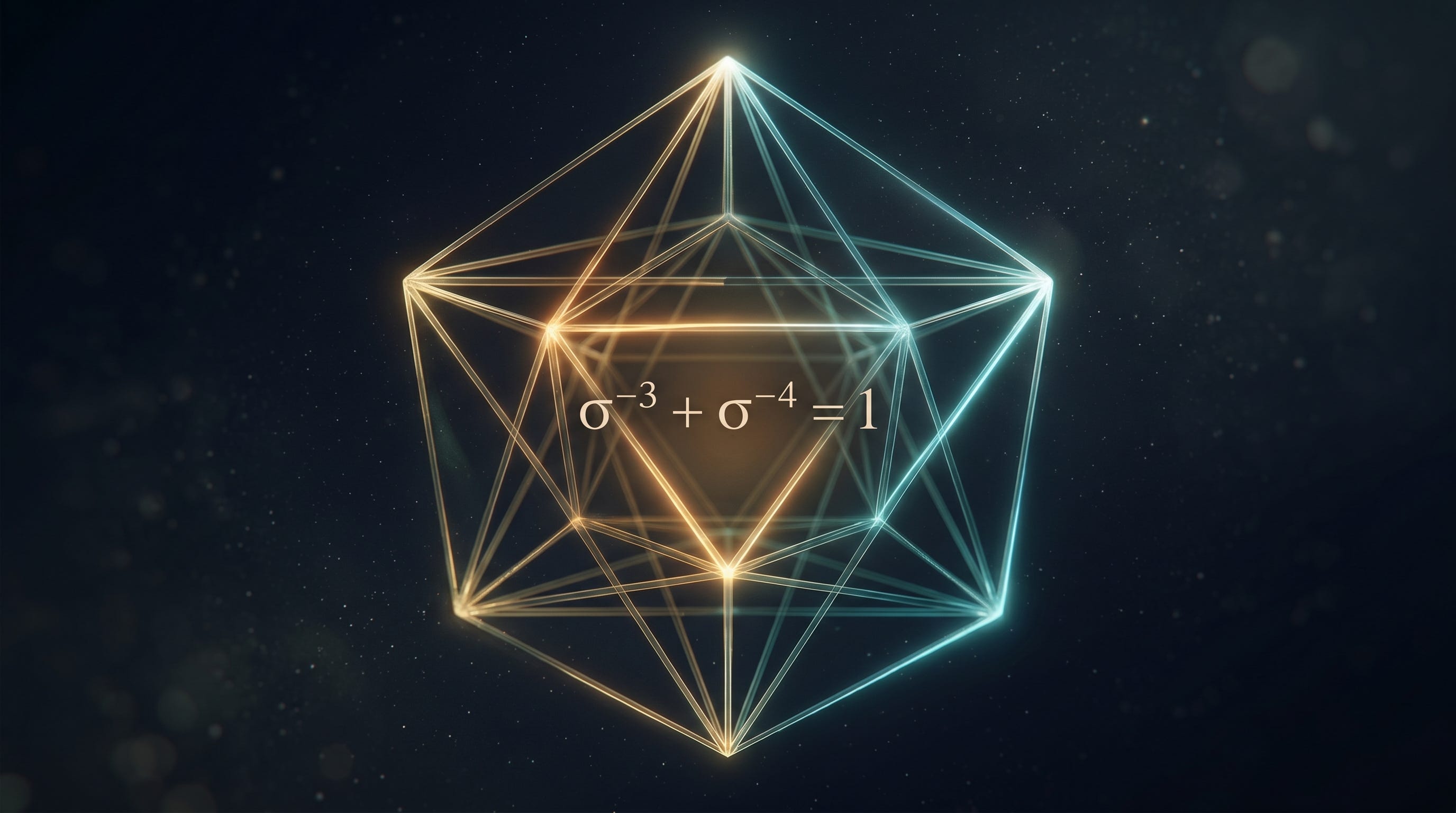
Every physical system has constants.
The speed of light. Boltzmann's constant. The fine-structure constant. These numbers define how a system behaves — how fast energy moves, how heat distributes, how fields interact. Without them, the equations are empty. With them, the equations describe reality.
Most constants are measured. You build an instrument, run an experiment, and read a number off the result. The number is what it is. You do not derive it — you observe it.
A few constants are derived. They fall out of the mathematics itself, before any experiment is run. $ \pi $ is one. The golden ratio is another. You do not measure $ \phi \approx 1.618 $ — you prove it. It is the unique positive root of $ x^2 = x + 1 $, and its value is fixed by algebra, not observation.
The distinction matters. Measured constants might have been different. The speed of light could, in principle, have been another number. But $ \pi $ could not. The golden ratio could not. They are consequences of structure — and structure does not negotiate.
The Three-Body Problem of Propagation
In Edition 1, we introduced σ — the unique positive root of $ x^4 = x + 1 $, approximately $ 1.22074 $. We showed that σ is the natural organizing constant of the $A_4$ root lattice: a four-dimensional geometric structure with 20 nearest neighbors, governed by the symmetry group of the regular pentatope.
In Edition 2, we proved that σ extends Van der Laan's self-similar subdivision to four dimensions, closing the system at exactly 35 proportional types — the combinatorial number $ C(7,3) $ — answering a question that had been open for sixty years.
But both editions treated σ as a parameter — a number the geometry selects. The deeper question is whether the geometry has something stronger. Not just a constant, but a law.
Here is what we mean.
How Wavefronts Propagate on a Lattice
When a wavefront propagates on a lattice — any lattice, in any dimension — it does not move uniformly. At each lattice site, the propagation has choices: it can step along a shared facet, traverse a full simplex interior, or continue along a higher-dimensional boundary. The geometry determines which paths exist. The constants determine how the growth distributes among them.
On the $A_4$ lattice, there are exactly two characteristic topological delays:
Mode 1: Three-step boundary path. Propagation proceeds through a tetrahedral face — a three-dimensional boundary shared between two simplices. This is the short path, the local connection. In the dominant-delay model, this path introduces a characteristic delay of 3 steps, scaling by a factor of $ \sigma^{-3} $.
Mode 2: Four-step interior path. Propagation proceeds through the full simplex — traversing all four dimensions of the pentatope. This is the long path, the deep connection. In the dominant-delay model, this path introduces a characteristic delay of 4 steps, scaling by a factor of $ \sigma^{-4} $.
These correspond to the shortest topological path lengths through the codimension-1 boundaries and the full dimensional interior of the simplex. Every propagation path on the $A_4$ lattice factors through these two characteristic delay channels.
The Identity
Now compute the growth partition fractions.
$ \sigma \approx 1.22074 $, so:
$$ \sigma^{-3} \approx 0.54970 $$ $$ \sigma^{-4} \approx 0.45030 $$
Add them:
$$ \sigma^{-3} + \sigma^{-4} = 1 $$
Not approximately 1. Not 0.99997. Not "within numerical precision."
Exactly 1.
$\sigma^{-3} + \sigma^{-4} = 1$ — Not approximately 1. Not 0.99997. Exactly 1.
Why This Is Not a Coincidence
This identity is not an empirical observation. It is an algebraic consequence of the defining equation $ x^4 = x + 1 $.
Here is the proof:
Theorem: Growth Partition Law ($d = 4$)
For the $A_4$ simplicial lattice, the growth partition fractions for the boundary and interior channels sum to unity:
$$\sigma^{-3} + \sigma^{-4} = 1$$Start with the defining equation for the $\sigma$-constant:
$$\sigma^4 = \sigma + 1$$Divide both sides by $\sigma^4$:
$$\frac{\sigma^4}{\sigma^4} = \frac{\sigma}{\sigma^4} + \frac{1}{\sigma^4}$$Simplify to yield the growth partition law:
$$1 = \sigma^{-3} + \sigma^{-4}$$That is the entire proof. Three lines. The identity is not discovered by computation — it is inherited from the polynomial that defines the constant. It is as provable as the Pythagorean theorem, and it is true on every machine, in every implementation, forever.
What This Means for a Lattice
In physical systems, conservation laws ensure that quantities like energy are neither created nor destroyed — only transferred between modes. In a dynamical propagation network, the partition of growth behaves in an analogous way.
The identity $ \sigma^{-3} + \sigma^{-4} = 1 $ is the growth partition law of the $A_4$ lattice wavefront.
It says: when a wavefront propagates across the lattice, its asymptotic growth is distributed between its two characteristic delay channels in a way that is exactly conserved. The two growth fractions — the short boundary path and the long interior path — sum to unity. The asymptotic growth rate partitions between the channels in a ratio fixed by pure algebra.
This is not a design choice. Nobody tuned σ to make this work. Nobody selected the ratios to satisfy a constraint. The partition law is the constraint, and σ is the only number in the real line that satisfies it for dimension 4.
We call this the Semantic Octave — because it functions like an octave in music. In music, an octave is the interval where a frequency doubles and returns to "the same note." In the $A_4$ lattice, the wavefront growth splits into two characteristic delay modes and partitions to unity. The geometry has a natural period, a fundamental cycle where the growth factors balance. The octave is that cycle.
The Family Pattern
The identity is not unique to dimension 4. It is universal.
In dimension 2, the golden ratio φ satisfies $ x^2 = x + 1 $, which gives:
$$ \phi^{-1} + \phi^{-2} = 1 $$Two characteristic delays on the triangular lattice. One-step (edge) and two-step (face). The growth fractions sum to 1.
In dimension 3, the plastic constant ρ satisfies $ x^3 = x + 1 $, which gives:
$$ \rho^{-2} + \rho^{-3} = 1 $$Two characteristic delays on the tetrahedral lattice. Two-step and three-step. The growth fractions sum to 1.
In dimension 4, the σ-constant satisfies $ x^4 = x + 1 $, which gives:
$$ \sigma^{-3} + \sigma^{-4} = 1 $$Two characteristic delays on the $A_4$ lattice. Three-step (tetrahedral face) and four-step (full simplex interior). The growth fractions sum to 1. This is the identity we derived above — the one Calera Computing's architecture is built on.
In dimension 5, $ c_5 \approx 1.16730 $ satisfies $ x^5 = x + 1 $:
$$ c_5^{-4} + c_5^{-5} = 1 $$In dimension 6, $ c_6 \approx 1.13472 $ satisfies $ x^6 = x + 1 $:
$$ c_6^{-5} + c_6^{-6} = 1 $$In general, for any dimension $ d \ge 2 $, the constant $ c_d $ satisfies $ c_d^d = c_d + 1 $, and the same three-line derivation yields its own partition law:
$$ c_d^{-(d-1)} + c_d^{-d} = 1 $$The identity is inherited from the polynomial, not discovered by computation. It holds in every dimension, for every constant in the hierarchy, by algebra alone — confirmed computationally for $ d = 2 $ through $ 20 $ using the verification scripts published alongside our second paper. The general derivation is in the appendix below.
Every lattice in the $A_d$ family has its own growth partition law. Every constant in the $ x^d = x + 1 $ hierarchy carries its own octave. The fractions change — φ splits roughly 62/38, ρ splits roughly 57/43, σ splits roughly 55/45, c₅ splits roughly 54/46, c₆ splits roughly 53/47 — but the sum is always exactly 1.
The deeper the dimension, the more equal the split. As $ d \to \infty $, the constant $ c_d $ approaches $ 1 + \ln(2)/d $, and both growth fractions converge to exactly 1/2. The partition law becomes perfectly symmetric. Isotropy — the same theme from Edition 2. As dimension grows, the geometry loses its bias, the two propagation modes become indistinguishable, and the octave resolves into a unison.
The Engineering Consequence
A lattice with a strict growth partition law is a lattice where the relative structure of propagating information is asymptotically stable.
If the growth rate is perfectly partitioned between the delay channels, then a pattern propagating through the lattice preserves its relative mode distribution. The ratio between the boundary and interior components converges to a fixed value. It does not drift over time, and it is not subject to numerical decay. It can be decoded by factoring out the global growth rate, leaving the relative structure identical to when it was initiated. Not "approximately the same." The same. Because the algebra guarantees the partition ratio.
This is the difference between a parameter and an identity.
A system built on tuned parameters is fragile. Change the parameter — adjust it by 0.1%, retrain a model, update a coefficient — and the system behaves differently. The old results are no longer reproducible. The new results depend on the new parameter. There is no mathematical guarantee that the system will behave the same way twice.
A system built on an algebraic identity is permanent. $ \sigma^{-3} + \sigma^{-4} = 1 $ does not change when you update software. It does not drift when you retrain. It does not vary between hardware platforms. It is an algebraic fact, derivable in three lines, and it will be true in a hundred years for the same reason it is true today: because $ x^4 = x + 1 $ has exactly one positive real root, and that root has this property. And if the architecture ever moves to a different dimension — a 5D lattice, a 6D lattice, any lattice in the family — the partition law moves with it. The octave is not a feature of one geometry. It is a feature of the entire hierarchy.
Architecture we build at Calera Computing is grounded in this identity. Not as an aspiration. As a mathematical constraint grounded in the geometry of the $A_4$ lattice and the universal hierarchy it belongs to.
What Comes Next
Edition 1 named the constants. Edition 2 proved they solve a counting problem. Here in Edition 3, we derived the growth partition law — boundary and interior fractions summing to one, universally, in every dimension.
In Edition 4, the hierarchy meets geometry. We project the four-dimensional A₄ root lattice onto the Coxeter plane and watch a Penrose tiling emerge — aperiodic, five-fold symmetric, and governed by the same golden ratio from Edition 1. The connection to quasicrystals is not a metaphor. It is a geometric consequence of the same root system.
Casey Lee Race, Founder King, Calera Computing, Inc.
📄 Paper: "The σ-Constant: A Universal Algebraic Invariant for Energy Propagation in d-Dimensional Simplicial Lattices" 🔗 DOI: doi.org/10.5281/zenodo.20350425 💻 Verification Scripts: github.com/Calera-Computing-Inc/sigma-constant-verification
📄 Paper 2: "The x^d = x + 1 Hierarchy: Cross-Dimensional Spectral Validation on A_d Root Lattices" 🔗 DOI: doi.org/10.5281/zenodo.20692936 💻 B02 Verification: github.com/Calera-Computing-Inc/cross-dimensional-hierarchy-verification
Appendix: The General Identity
Theorem: General Growth Partition Law
For any dimension $d \ge 2$, let $c_d$ be the unique positive real root of the characteristic polynomial $x^d = x + 1$. The growth partition fractions for the boundary and interior propagation channels always sum to unity:
$$c_d^{-(d-1)} + c_d^{-d} = 1$$Start with the defining characteristic equation:
$$c_d^d = c_d + 1$$Divide both sides by the leading power term $c_d^d$:
$$\frac{c_d^d}{c_d^d} = \frac{c_d}{c_d^d} + \frac{1}{c_d^d}$$Simplify the ratios to yield the general partition law:
$$1 = c_d^{-(d-1)} + c_d^{-d}$$The two growth fractions partition unity in every dimension. The first members of the family are φ ($d = 2$), ρ ($d = 3$), and σ ($d = 4$). The identity was verified computationally for $d = 2$ through $20$.